WonderHome
Consumer · Family AI · Live product · early households onboarding
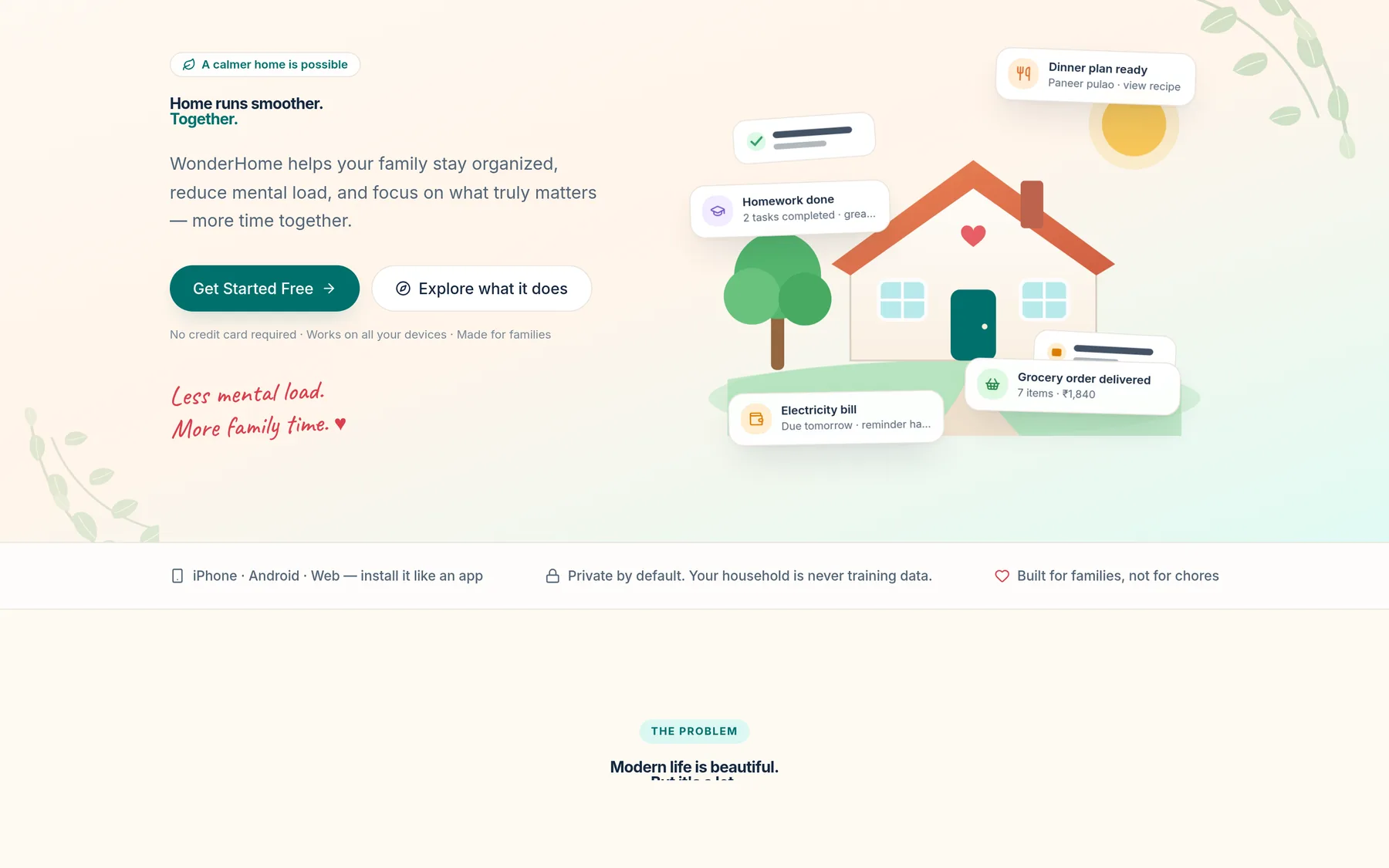
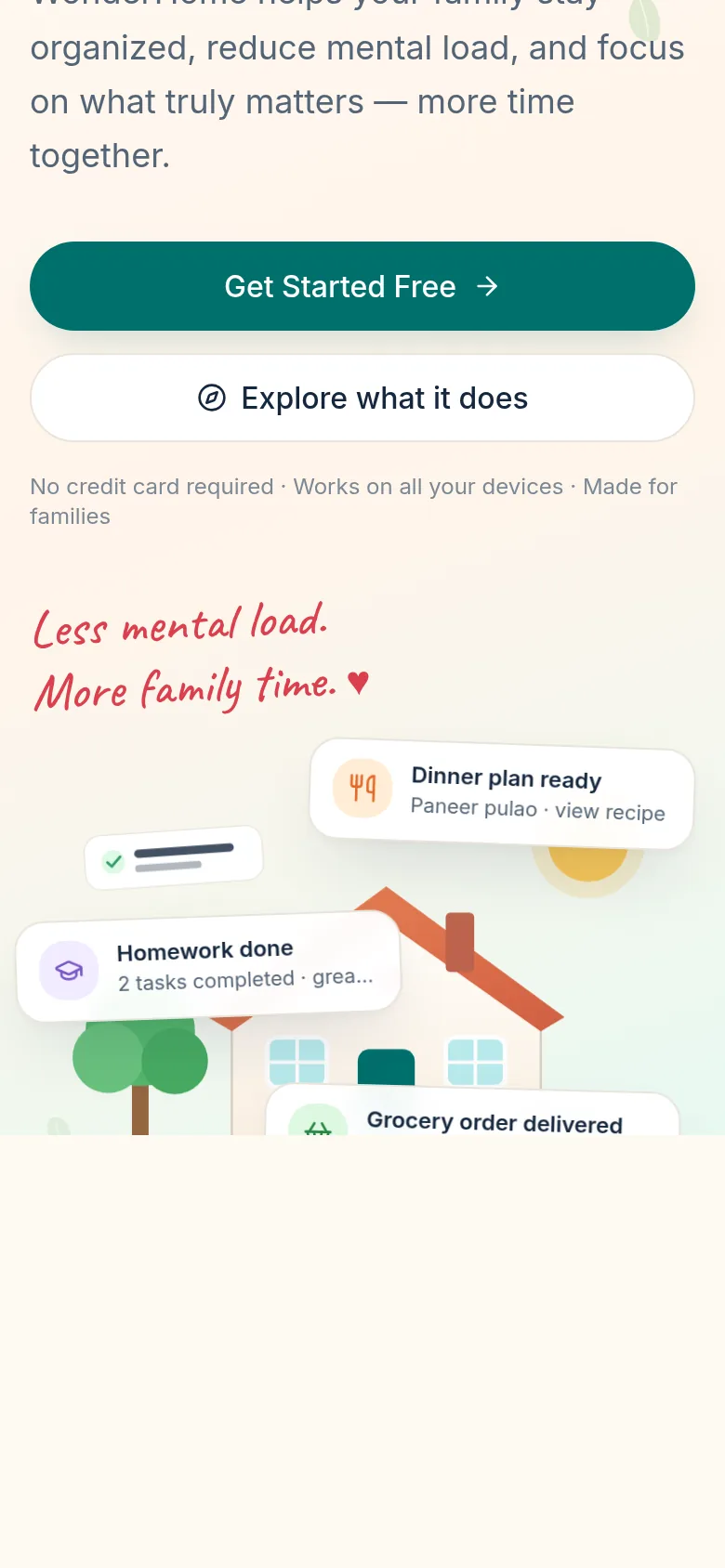
A calmer home is possible.
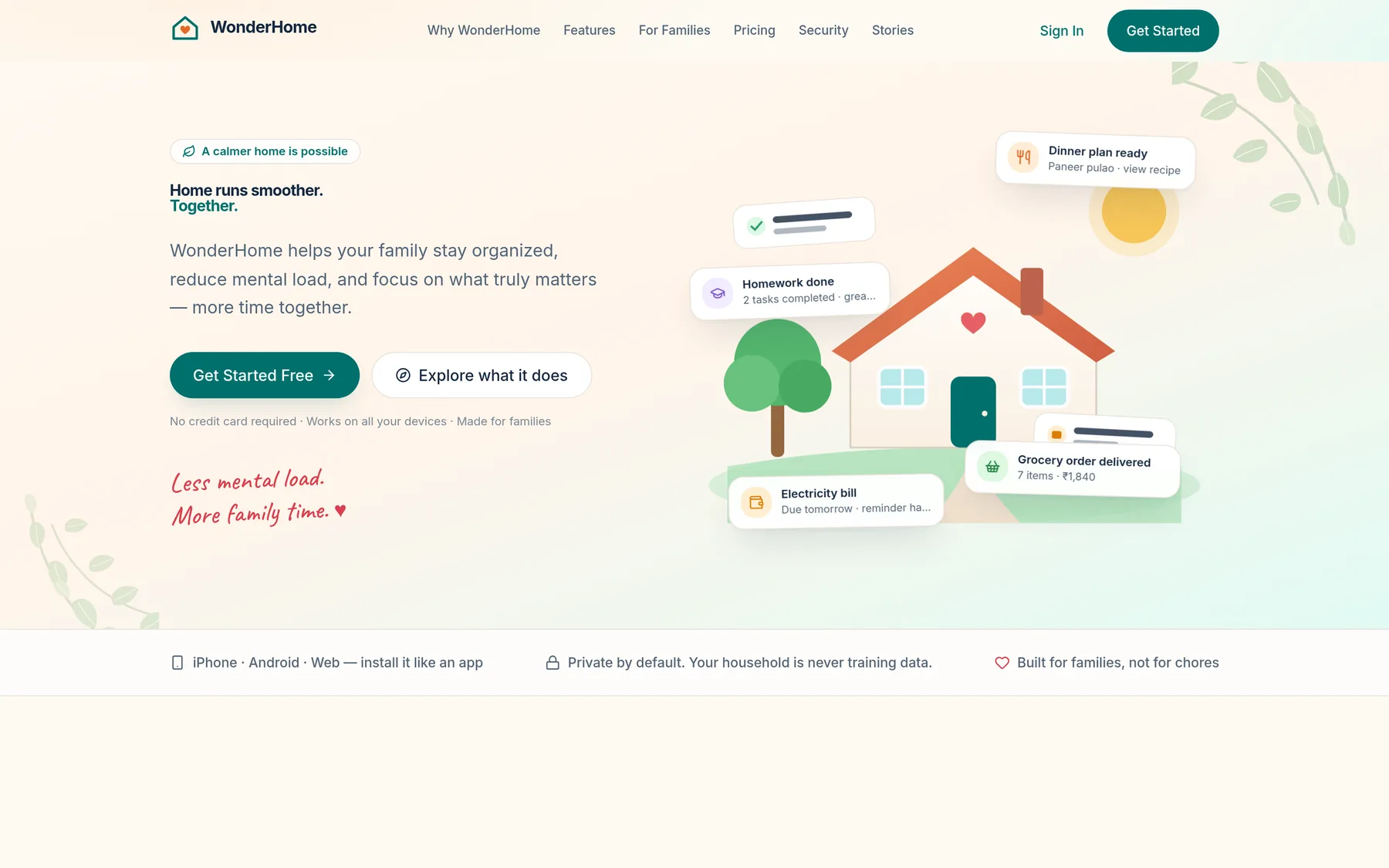
WonderHome watches the whole household — school, meals, groceries, bills, help, pets, family time — and interrupts the right person only when a decision is genuinely needed.
- Platform
- Web · PWA · iPhone · Android · Desktop
- AI
- Anthropic Claude primary; Gemini and OpenAI supported; BYOK
- Data
- Supabase PostgreSQL, RLS per household, ap-south-1
- Pricing
- Free · Pro · Max (no card for Free)
The problem
The management of life can consume the life itself.
Modern family life is beautiful, but it is a lot. Every existing tool adds another list for one parent — usually the same parent — to maintain.
- 1
Invisible mental load
Tasks, schedules, bills, shopping and school information never end, and they land disproportionately on one person.
- 2
Tools that add work
Shared calendars, to-do apps and family chat groups all need feeding. None of them notice what is slipping.
- 3
Decisions at the wrong moment
A bill is noticed when it is overdue. A science project is discovered the night before. Dinner is a question at 7 pm.
- 4
Trust is the barrier
Families will not hand a home to software that acts without asking, or that treats children like adults.
The product
It manages the management.
WonderHome does not give a family more things to manage. It holds household outcomes, resolves routine work where the family's policy permits, and asks — clearly, with a plan — before anything consequential.
01
Outcomes, not chores
A meal is 'ready by 8 pm', a bill is 'paid before the consequence', homework is 'finished with time to spare'. The system plans backwards from the outcome.
02
Asks before it acts
Every consequential action shows what it understood, what it plans and the impact — with Confirm, Change and Cancel. Payments, deletions and access changes always ask.
03
Whole-household coverage
Family & profiles, Today, School, Groceries, Meals, Bills, Househelper, Maintenance, Laundry, Pet care and Family time — one place, one assistant, text or voice.
04
Private by design
Tenant isolation is enforced in the database, children get age-appropriate views, and household data is never training data.
How it works
From signal to outcome.
Step 1
Observe
Connected calendars, school portals, email and the family's own words tell WonderHome what is happening.
Step 2
Understand & Plan
Outcomes are checked against time, people and stock. A plan is drafted only when something is at risk.
Step 3
Act (with consent)
Routine work resolves silently within policy. Anything consequential returns as a plan the family confirms.
Step 4
Monitor & Learn
Notifications are sparse, threaded and resolve themselves. The household's preferences shape what comes next.
Product tour
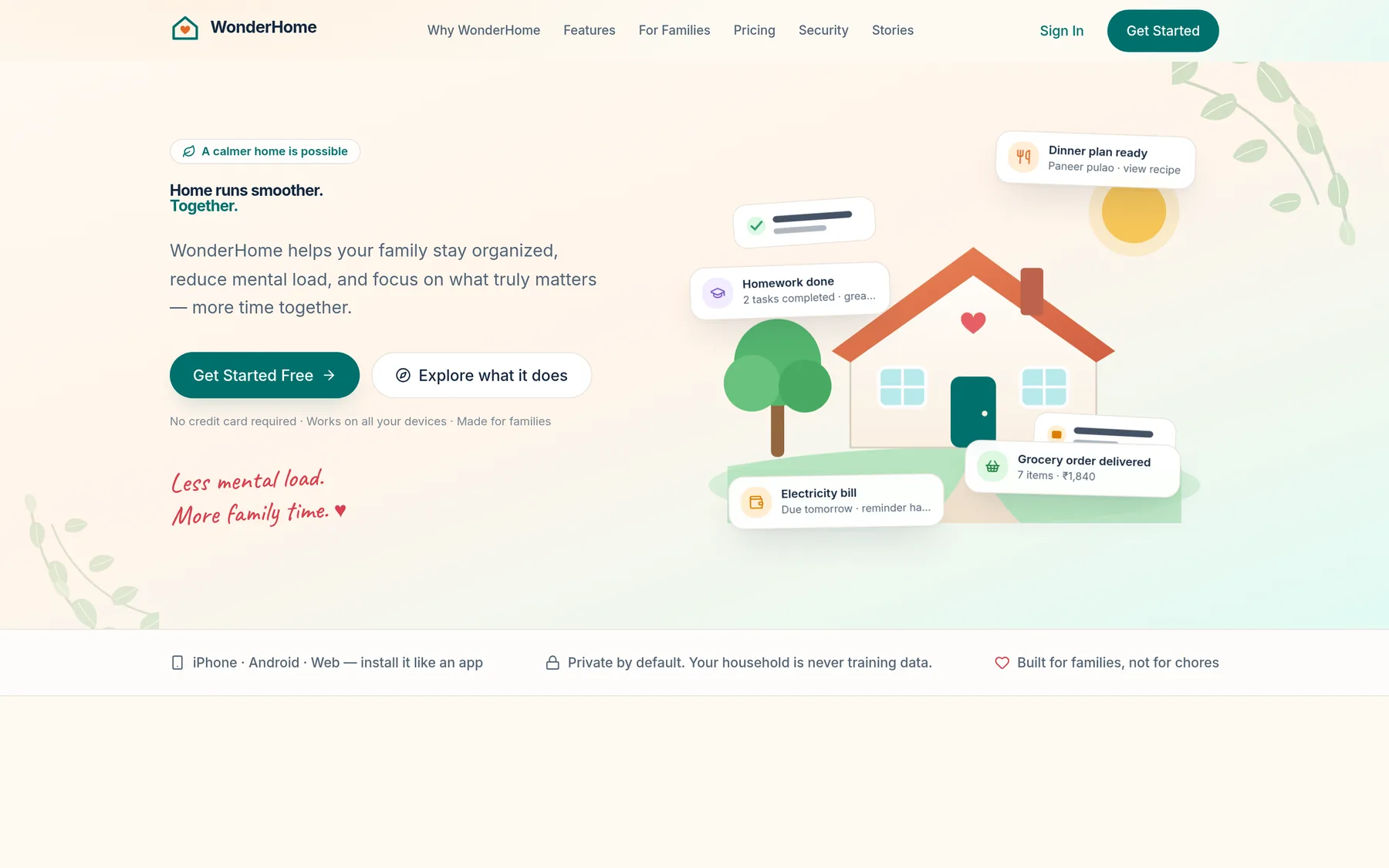
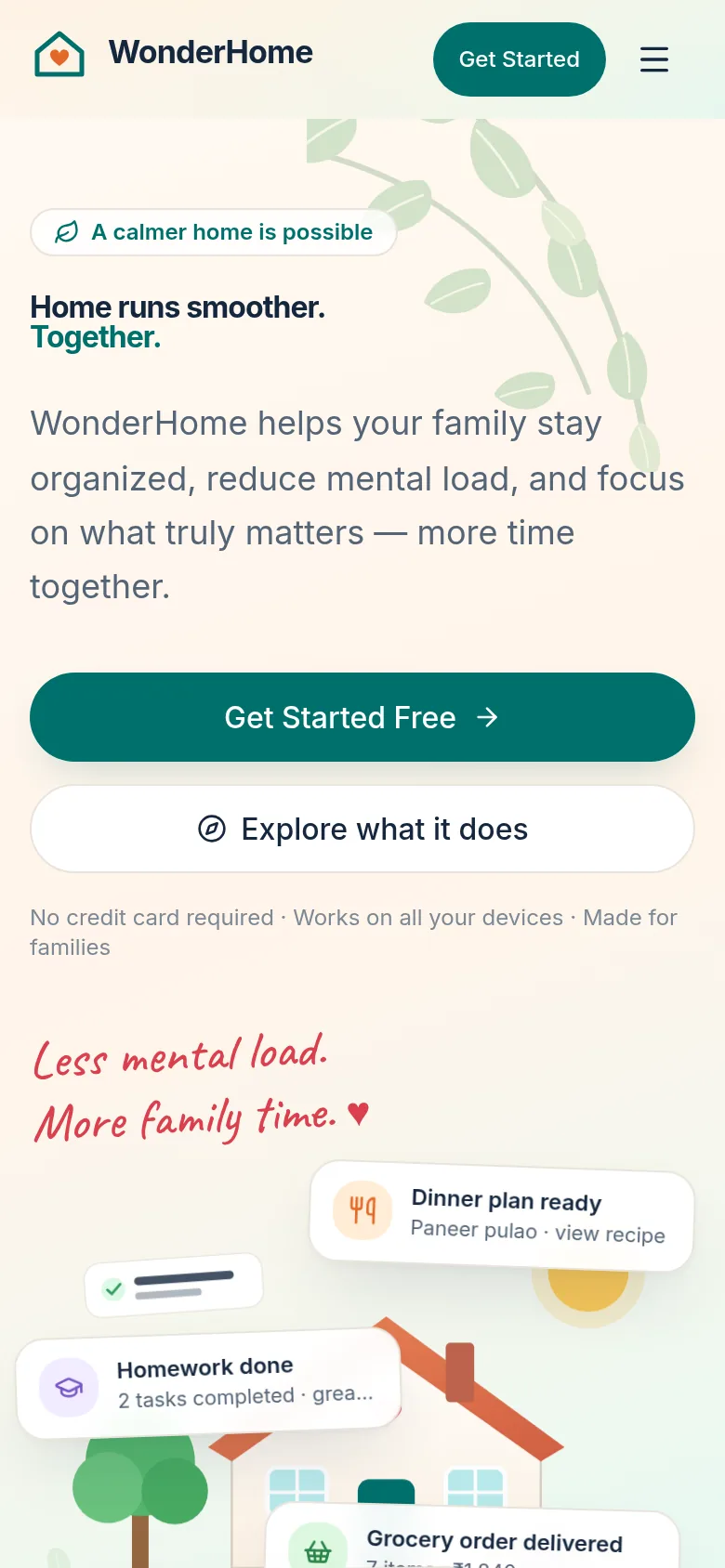
Desktop and mobile, one product.
Captured from the deployed product. Some views show demonstration data.
The product site — same design language as the app
Installs like an app on iPhone and Android
Every feature is a household outcome
Three plans, from a quiet watcher to a home that runs itself
Private by default — security as a family feature
Market & why now
Every family is a household to run.
Dual-income, multi-generational homes with school-age children, domestic help and dense admin are the norm across India's metros and a fast-growing share of homes worldwide. They already pay for convenience — delivery, tutoring, help — but nobody sells them coordination.
Who buys
- Urban dual-income families with school-age children
- Multi-generational households coordinating help and care
- Expat and NRI families running homes across time zones
Why now · 1
Assistants that can plan and act — not just answer — became reliable enough to run background loops in 2025–26.
Why now · 2
Household commerce, school portals and calendars all now have programmatic surfaces to observe and act on.
Why now · 3
Consumer trust hinges on consent-first design; WonderHome's governed-tool architecture is built for exactly that.
Business model
Consumer subscription with a governed path to commerce.
Plans are data, not code: Free, Pro and Max are rows in a live catalogue with server-side entitlements and atomic usage metering already shipped. Commerce and bill flows are designed with idempotent, approval-gated execution — the foundation for transaction revenue later.
Free
Run the Home
- Household basics with WonderHome watching quietly
- Outcomes, routines, notifications
- Maintenance, laundry, pet care
- Text conversation and background runs
Pro
Let WonderHome Think
- The full household: school, commerce, meals, bills, family time
- Voice conversation
- School and homework intelligence
- Ordering and groceries
Max
Let WonderHome Run the Home
- Everything, with autonomous action
- Deeper integrations
- Highest usage limits
Defensibility
What compounds.
Consent architecture
Deterministic policy checks sit outside the model. Autonomy is set per household, per responsibility. This is hard to bolt on and is the reason families will let it act.
Household graph
People, guardianship, protected time, stock levels, obligations and preferences form a private, compounding model of one home.
Cost discipline
Engineering guardrails target under US$2,000/month infrastructure at 10,000 active households and under US$0.75 of background AI per household per month.
Execution to date
Verifiable, not aspirational.
Pulled from the product's own public engineering trackers. Source code, trackers and live demos are available to serious parties on request.
Stories shipped
132 / 170
77.6% of a 21-module backlog, per the live tracker
Modules complete
8 of 21
Conversation, School, Commerce, Meals, Bills, Family time, Maintenance & Pet care, Bootstrap
Connectors live
Calendar · Email · School
On one shared connector contract; commerce adapter in progress
Scale target
25,000 households
99.9% availability, p95 ≤ 500 ms API — initial engineering targets
Roadmap
What comes next.
Now
- Commerce connector for live grocery ordering
- Household certification & understanding
- Privacy, security and governance stories to 8/8
Next
- Upgrade/downgrade and billing abstraction
- Platform admin and operations
- Public API and developer platform
Later
- Payment provider integration under step-up approval
- Quota automation and plan experiments
- Regional expansion beyond India
The ask